Implementing Restaurant Automation to Drastically Reduce Labor Costs
The hospitality sector is currently facing a structural labor crisis. Traditional service models built on high headcount and manual processes are no longer financially viable. Minimum wage escalations, chronic understaffing, and razor-thin profit margins are forcing operators to fundamentally re-engineer how they process orders and deliver food.
Automation in the restaurant space is no longer a luxury reserved for enterprise fast-food chains; it is a baseline requirement for independent survival. By systematically stripping away the friction points in your front-of-house (FOH) and back-of-house (BOH) operations, you can maintain high throughput with a fraction of the traditional labor footprint. Here is the consultant-grade blueprint for deploying technology that actually impacts your bottom line.
The Front-of-House (FOH) Digital Transformation
The traditional dining loop is incredibly inefficient. A server walks to a table to drop off menus, walks away, returns to take the order, walks to a POS terminal to punch it in, and eventually returns to handle a multi-step payment process. This physical repetition wastes countless man-hours.
Deploying a mobile QR ordering system eliminates this loop entirely. By empowering the guest to scan, browse, order, and pay directly from their smartphone, you shift the administrative burden of the transaction off your payroll and onto the consumer.
This does not destroy hospitality; it enhances it. Your reduced FOH staff no longer act as data-entry clerks fighting over POS terminals. Instead, they become dedicated "food runners" and floor managers, focusing entirely on quality control, table maintenance, and guest satisfaction. According to industry data from The National Restaurant Association, operations utilizing self-ordering tech report table turnover rates increasing by up to 15%.
Automated Upselling: The Silent Revenue Generator
Human servers are inconsistent. During a Friday night dinner rush, even your best server will forget to ask, "Would you like to add loaded fries or a premium cocktail to that?" Digital systems do not forget.
When you utilize digital menu boards and mobile interfaces, you can program algorithmic upselling. If a user selects a burger, the software automatically triggers a high-conversion visual prompt for a high-margin side dish. This automated engineering consistently drives up Average Order Value (AOV) by 20% to 30%, adding pure profit to your top line without increasing your marketing spend.
Back-of-House (BOH) Command Centers
Automating your ordering process is useless if your kitchen cannot handle the velocity of incoming data. Paper tickets are the enemy of scale. They get lost, stained with grease, or misread, resulting in costly remakes and food waste.
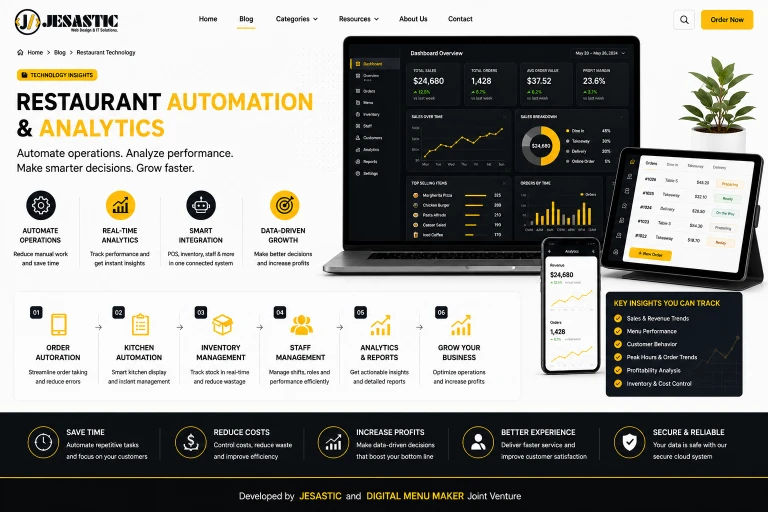
Transitioning to a Kitchen Display System (KDS) synchronizes your BOH with your automated front-end. When a mobile or kiosk order is placed, it routes instantly to the correct prep station (e.g., drinks go to the bar screen, entrees to the grill screen). The KDS automatically tracks ticket times, color-coding delayed orders to keep the line chief aware of bottlenecks before they impact the guest.
API and POS Integrations: The Central Nervous System
A common mistake operators make is purchasing fragmented technology—a delivery tablet from one company, a digital board from another, and a mobile ordering app from a third. This creates "tablet hell" at your front counter, forcing cashiers to manually re-enter orders into your master POS.
To achieve true automation, your digital menu infrastructure must utilize open API integration. Whether you are running legacy on-premise systems or modern cloud software, your customer-facing menus must push data directly into your central POS. This ensures that when an ingredient is 86'd (sold out) in the kitchen, it instantly disappears from your digital signage and mobile platforms, preventing customer frustration and refund processing.