Keep the Lunch Line Moving with a Smart Cafeteria Digital Menu
When the lunch bell rings, you don't have time for confusion. Communicate daily meal changes, critical allergen warnings, and nutritional information instantly with high-visibility digital boards designed for schools and universities.
Modernize Your Cafeteria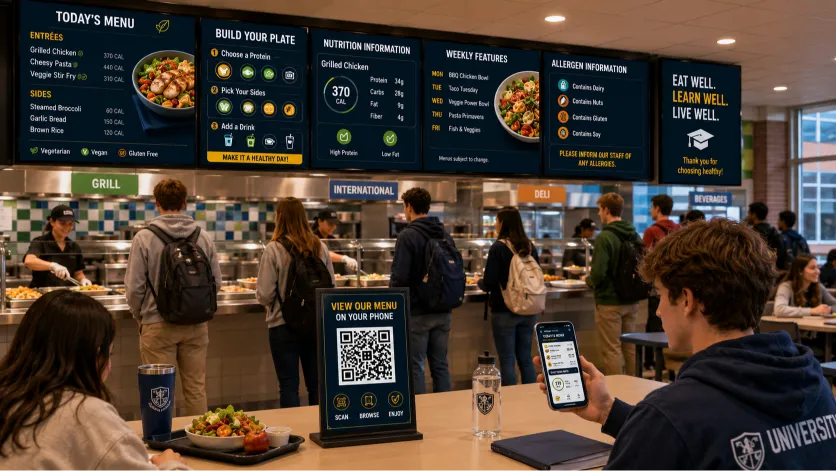
Accelerate the Lunch Line
When students know exactly what's being served before they reach the counter, throughput skyrockets. Eliminate the "What is that?" questions slowing down your staff.
Real-Time Supply Fixes
If the delivery truck shorts your tater tots, you can instantly update the digital screens to show french fries. No more crossing out items on a printed monthly calendar.
Allergy Safety Compliance
Protect your students and your institution. Clearly display peanut-free, gluten-free, and dairy-free badges on bright screens so students can eat with confidence.
Why Schools & Universities Need Digital Menus
Running a school cafeteria is an incredibly high-pressure logistical challenge. Unlike a traditional restaurant where guests arrive steadily throughout the day, a cafeteria experiences massive, concentrated bursts of traffic. You have roughly 25 to 30 minutes to feed hundreds of students before the next bell rings. In these environments, hesitation is the enemy of efficiency. If five students stop at the front of the line to ask the lunch staff what the side vegetable is, the entire queue backs up, and kids at the end of the line run out of time to eat.
This is why a highly visible cafeteria digital menu is not a luxury; it is an operational necessity. By mounting large, bright digital screens at the entrance of the cafeteria and above the serving lines, students can make their meal decisions while they are waiting in the queue. By the time they reach the counter, they simply point and move. You can see how this structural clarity works in our school cafeteria demo.
Furthermore, education food service is uniquely vulnerable to supply chain disruptions. The printed monthly menu that you sent home with students on the first of the month is almost guaranteed to be inaccurate by the 15th. When your distributor fails to deliver the chicken nuggets, a digital system allows you to instantly swap the menu to pizza across all screens, preventing confusion and complaints from parents.
Modernizing with School Lunch Digital Signage
For K-12 environments, school lunch digital signage serves a dual purpose: speed and education. Modern cafeterias are utilizing digital boards to not only display the food but to encourage healthy eating habits. You can partition a digital display to show the hot lunch options on the left, while the right side of the screen runs a colorful graphic explaining the nutritional benefits of the day's fresh fruit offering.
Our cafeteria menu board solutions also allow for seamless dayparting. A high school cafeteria often serves a morning breakfast break and a mid-day lunch. Instead of staff manually flipping physical signs, the digital system automatically transitions from displaying breakfast sandwiches at 7:30 AM to displaying burgers and salads at 11:00 AM. This automation frees up your cafeteria staff to focus strictly on food prep and sanitation.
This level of automated menu scheduling is the exact same technology utilized by high-volume fast food restaurants to manage their morning-to-afternoon shifts, ensuring that signage always matches what the kitchen is actually producing.
Scaling Up: University Dining Hall Menus
When you transition from K-12 to higher education, the complexity of food service multiplies exponentially. A modern university dining hall is essentially a massive food court, often featuring a grill station, a vegan bar, a global cuisine station, and a dedicated allergy-safe zone. Managing university dining hall menus requires a robust, centralized digital infrastructure.
With our platform, dining directors can build a master ingredient database and route specific menu categories to specific screens. The screen above the grill only shows burgers and fries, while the screen above the salad bar shows the rotating daily soups. More importantly, university students belong to a mobile-first generation. They expect to know what's for dinner before they even leave their dorm room.
By utilizing our system, universities can generate live URLs and QR codes that integrate seamlessly into the campus app. Students can browse the dining hall menus on their phones, check for their specific dietary restrictions, and even utilize interactive order features for late-night campus delivery or grab-and-go pickup. This omnichannel approach mirrors the premium service expected in top-tier hospitality and hotel environments.
The Importance of Nutritional Menu Boards
In educational food service, food safety and nutritional compliance are strictly regulated. Displaying accurate nutritional menu boards is often a legal requirement, not just a preference. Whether you need to comply with federal calorie display mandates or you simply want to provide transparency to student-athletes tracking their macros, digital screens are the only practical solution.
Trying to cram calorie counts, protein grams, and allergen warnings onto a printed menu board creates a cluttered, unreadable mess. A digital system allows you to cleanly append standardized dietary badges (e.g., a green leaf for Vegan, a yellow shield for Gluten-Free, a red warning for Contains Peanuts) directly next to the item name. This visual shorthand allows students with severe food allergies to navigate the cafeteria safely and independently.
Just as stadium food courts must process thousands of people safely during a halftime rush, a school cafeteria must process students rapidly without ever compromising on safety. By centralizing your menu data, you ensure that if an ingredient changes in the kitchen, the allergen warning updates instantly on the screen. Before finalizing your vendor contracts and meal pricing for the upcoming semester, we recommend utilizing our restaurant finance tools to ensure your cafeteria operates within its strict budget while maintaining these high safety standards.
Explore More High-Volume Solutions
Frequently Asked Questions
Unlike printed monthly calendars that become instantly outdated when supply chains shift, a digital menu operates from a central online dashboard. If your food vendor shorts your delivery of chicken patties, you can instantly log in and swap the digital screen to display pizza, keeping students informed in real-time and preventing confusion at the counter.
Yes. Food safety is paramount in educational environments. You can assign specific dietary badges (e.g., Peanut-Free, Gluten-Free, Dairy-Free, Vegetarian) to items in your backend database. These icons render clearly next to the food names on the digital boards, ensuring students and staff can make safe choices quickly.
In a large university dining hall, you might have a grill station, a salad bar, and a global cuisine station operating simultaneously. Our system allows you to build a master inventory and selectively broadcast specific categories to specific screens located above each physical station, keeping the flow organized and logical.
Absolutely. Because the menus are cloud-based, you can generate a live URL or a QR code that links directly to your daily offerings. Students can check the digital menu from their dorm rooms or classrooms via their smartphones to see what's being served before deciding to walk to the cafeteria.
Yes. For universities and institutions required by state or federal law to display caloric intake, our digital menus allow you to cleanly input calorie counts, macros, and nutritional facts right alongside the item description. This ensures total legal compliance without cluttering the screen or confusing the reader.
Ready to Upgrade Your Campus Dining Experience?
Stop relying on outdated printed calendars. Centralize your cafeteria menus, communicate nutritional information clearly, and keep the lunch line moving faster than ever.
View Pricing & Plans