Control the Chaos with a Cloud Kitchen Digital Menu
Stop drowning in "tablet hell." Manage multiple virtual restaurant brands, streamline your delivery-first ordering systems, and update prices across all your concepts from one centralized digital hub.
Build Your Multi-Brand Hub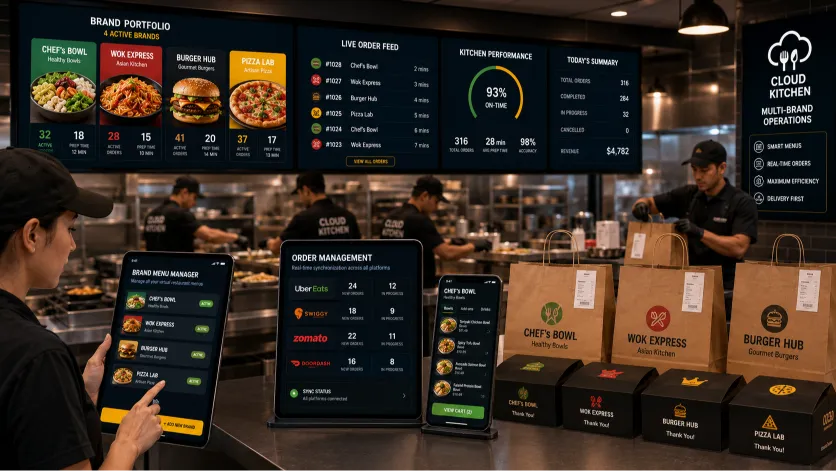
Multi-Brand Agility
Run a burger concept, a taco stand, and a vegan bakery from the same kitchen. Manage completely separate digital menus from a single dashboard.
Instant Global 86'ing
When you run out of an ingredient, pause it once. The system instantly updates every relevant virtual brand menu so you never sell food you don't have.
Direct Delivery Orders
Stop paying 30% commissions on every ticket. Generate direct ordering links for your social media channels and keep your hard-earned margins.
Why Cloud Kitchens Need a Centralized Digital Menu
Operating a cloud kitchen is fundamentally different from running a traditional brick-and-mortar restaurant. You do not have the luxury of foot traffic, a neon sign, or an engaging host to sell your food. In the ghost kitchen world, your digital presence isn't just a marketing tool; it is your entire storefront. If your digital infrastructure is slow, fragmented, or confusing, your restaurant practically doesn't exist.
The core advantage of a cloud kitchen is the ability to cross-utilize inventory. You might be buying bulk chicken thighs to power a fried chicken brand, a teriyaki bowl brand, and a late-night wing concept all at once. The culinary math makes sense, but the digital execution often falls apart. Managing three separate brands usually means managing three separate ecosystems, leading to the infamous "tablet farm" phenomenon—where a wall of iPads constantly chimes, and your expediter is losing their mind trying to figure out which brand an order belongs to.
Implementing a proper cloud kitchen digital menu architecture solves this instantly. It gives you a unified master inventory system. When you look at your dashboard, you aren't managing 50 different items; you are managing your core ingredients. This operational efficiency is exactly what separates struggling pop-ups from highly scalable virtual restaurant empires. You can see this centralized workflow in action by exploring our cloud kitchen demo.
Mastering Dark Kitchen Menu Management
Let's talk about the reality of a Friday night rush in a dark kitchen. The delivery drivers are hovering outside, the tickets are printing relentlessly, and suddenly your line cook shouts that you are entirely out of brioche buns. In a poorly managed kitchen, a manager has to frantically log into UberEats for Brand A, DoorDash for Brand B, and GrubHub for Brand C to manually 86 every single burger, sandwich, and slider that uses that bun.
By the time they finish updating the 9th tablet, three more orders have slipped through that you now have to cancel, hurting your algorithmic ranking on the delivery apps. Effective dark kitchen menu management eliminates this nightmare. With our centralized system, you 86 the brioche bun once in the master control panel. The system intelligently scans all your active virtual brands, identifies every menu item utilizing that bun, and immediately pauses them globally.
This level of synchronization is non-negotiable if you plan to operate multiple concepts. It is the same fundamental logic required when operating high-volume fast food restaurants, where speed of service and exact inventory alignment dictate whether a shift is profitable or chaotic.
The Shift Toward Direct Virtual Restaurant Ordering
Third-party delivery apps are a double-edged sword. They are unparalleled for customer acquisition and initial brand discovery, but the 30% commission fees will slowly bleed a cloud kitchen dry. To build a sustainable, long-term business, you must transition your loyal customers away from the major apps and into your own direct virtual restaurant ordering ecosystem.
When you build your menu infrastructure with our tools, you can generate direct, highly-optimized mobile ordering links for each of your specific brands. You drop the link for your wing concept into its dedicated Instagram bio, and you push the link for your vegan concept to its specific email list. When a customer clicks, they aren't taken to a crowded app where your competitors are listed right below you; they are dropped into a beautiful, seamless, branded digital menu.
Because you control the ordering flow, you control the data and the upselling. You can program the menu to suggest adding a $3 dipping sauce or a $4 premium beverage before checkout, directly padding your bottom line. Test this specific flow by reviewing our interactive order demo to see how smooth the direct-to-consumer experience can be.
Scaling with a Multi-Brand Digital Menu
The magic of the cloud kitchen model is rapid iteration. If you launch a gourmet hot dog brand on Monday and realize by Friday that the market simply isn't responding, you don't have to break a commercial lease or fire a front-of-house staff. You simply kill the brand digitally and spin up a new grilled cheese concept by the following Tuesday.
However, this agility requires a robust multi-brand digital menu infrastructure. You cannot afford to pay a web developer every time you want to pivot. Our platform acts as your cloud kitchen dashboard, allowing you to clone existing menus, swap out logos, adjust the brand color hex codes, and generate a new live URL in minutes. You can even run A/B pricing tests—selling the exact same bowl of mac and cheese under two different brand names at two different price points to see which converts better.
Many modern operators are even combining these virtual concepts with physical footprints, operating ghost kitchens out of the back of food trucks or commissary spaces. Whether you are dealing with walk-up QR code scanners or a fleet of delivery drivers, unifying your menu management is the only way to scale without losing your operational sanity. Don't forget to leverage our restaurant finance tools to constantly monitor the food cost percentages of each distinct brand you operate.
Expand Your Delivery Infrastructure
Frequently Asked Questions
A multi-brand digital menu operates from a centralized dashboard. You upload your core ingredient inventory once, and you can map those ingredients across multiple virtual brands. When you update a price or 86 an item, it automatically syncs across the specific menus for your burger brand, wing brand, or vegan concept simultaneously, keeping your kitchen aligned.
Yes. While 3rd party delivery apps are great for discovery, they take massive commissions. Our system allows you to generate direct ordering links for each of your virtual brands, letting you capture commission-free orders directly from your social media profiles, email lists, and local marketing efforts.
Almost instantly. Because your infrastructure is purely digital, launching a new brand is as simple as creating a new menu category, uploading a new logo, adjusting the brand colors, and publishing the link. There are no physical signs to print or front-of-house logistics to manage, allowing for rapid A/B testing of culinary concepts.
Absolutely. Many operators use the same prep space to serve walk-up food truck customers via QR codes while simultaneously running multiple delivery-only brands out the back door. The central digital dashboard manages all of these distinct menus without creating kitchen chaos, allowing you to maximize the revenue per square foot of your kitchen.
This is a core feature of dark kitchen menu management. Instead of frantically logging into different tablets to remove items that use a shared ingredient, you pause the ingredient in your master dashboard. The system intelligently hides the related items across all your active brand menus instantly, preventing canceled orders and upset delivery drivers.
Ready to Scale Your Virtual Brands?
Ditch the tablet farm and the operational chaos. Unify your dark kitchen menu management into a single, high-performance digital hub and protect your delivery margins.
View Pricing & Plans